

Every browser you’ve ever used, until Cloudflare’s latest release, was designed around a fundamental assumption: a human is going to look at it.
Tabs, themes, smooth scrolling, pixel-perfect rendering, all of it exists because eyes and hands are on the other end. Cloudflare just threw that entire assumption out the window.
The company spent twelve weeks building a browser with no tabs, no themes, and no particular interest in looking good, because the thing using it was never going to see it the way we do. It’s called Kitesurf, and I think it might be one of the more quietly significant infrastructure releases of the year for anyone building AI agents.
What Kitesurf Actually Is
Cloudflare describes Kitesurf as a stateless, highly scalable web browser that runs entirely on top of its Workers platform, built specifically for what the company calls the Agentic Cloud rather than for human users.
The reasoning behind it, as Cloudflare tells it, comes down to a genuinely simple observation I hadn’t fully considered until reading their own framing: AI doesn’t care about tabs, themes, extensions, or syncing across devices. It cares about token count, context windows, scalability, and cost. And traditional browser engines like Chromium were never built with those priorities in mind, meaning every AI agent that needs to browse the web has been paying for overhead it never actually uses.
Why Cloudflare Decided To Build Its Own Browser
I find the origin story here more interesting than most product launch narratives. According to Cloudflare’s own account, the idea of building an in-house browser had come up internally “every few months” for years and had always been shelved, largely because the technical difficulty never seemed to justify the payoff. What changed, per the company, was a convergence: WebAssembly support in Workers matured, new primitives like Dynamic Workers and SQLite-based Durable Objects became available, and the demand for agent-native browsing exploded at the exact same moment those capabilities came together.
Cloudflare says the project started from a Rust-based headless engine called Obscura, which an AI agent then helped port onto Workers, initially failing before eventually producing a working proof of concept once the team gave the AI a clear enough plan to iterate against. That’s a detail I think deserves more attention than it’s gotten elsewhere: Kitesurf isn’t just a browser for AI agents, it was substantially built with the help of one.
How It’s Built, And What Makes It Genuinely Different
This is where I think Kitesurf earns real credit for architectural ambition rather than just marketing framing. The browser is split into three core components: the Engine, which handles the Chrome DevTools Protocol and session state; PageScript, which parses HTML and CSS using Rust-based tools called Blitz and Stylo and executes JavaScript inside isolated Dynamic Workers; and PageRenderer, which turns the resulting page object into actual pixels using Workers’ built-in RPC system to communicate statelessly between components.
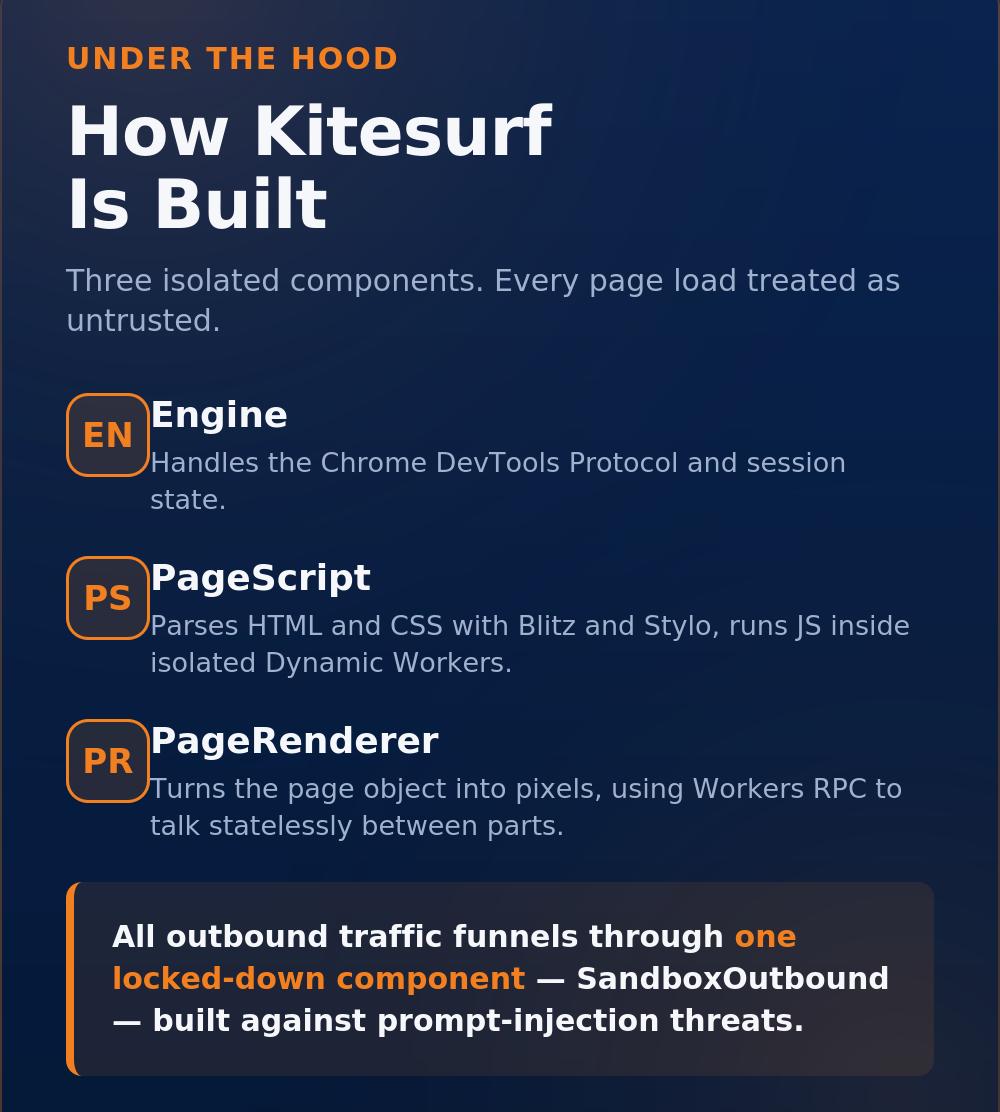
What’s genuinely unique here, in my assessment, is the security model baked into that architecture. Cloudflare treats every single page load as untrusted input by default, isolating each component so that nothing can touch resources it doesn’t strictly need, and routing all outbound network requests through one single locked-down component called SandboxOutbound. Given that AI browsers face fundamentally different threats than human ones, particularly prompt injection attacks embedded in web content, that isolation-first design feels like a genuinely considered response rather than an afterthought bolted onto an existing browser.
The Performance Numbers, According To Cloudflare’s Own Testing
Here’s where the pitch gets measurable rather than just aspirational. Based on Cloudflare’s own benchmarks across a 14-URL test corpus, Kitesurf used 3.1 times less CPU than a warm-pool Chromium instance for screenshot capture, and 3.8 times less for HTML extraction. On memory, the gap was even larger: 4.7 times less for screenshots and 7.0 times less for HTML extraction. Since memory and CPU are exactly what drive cloud infrastructure bills, that’s a genuinely meaningful cost argument for anyone running AI agents at scale.
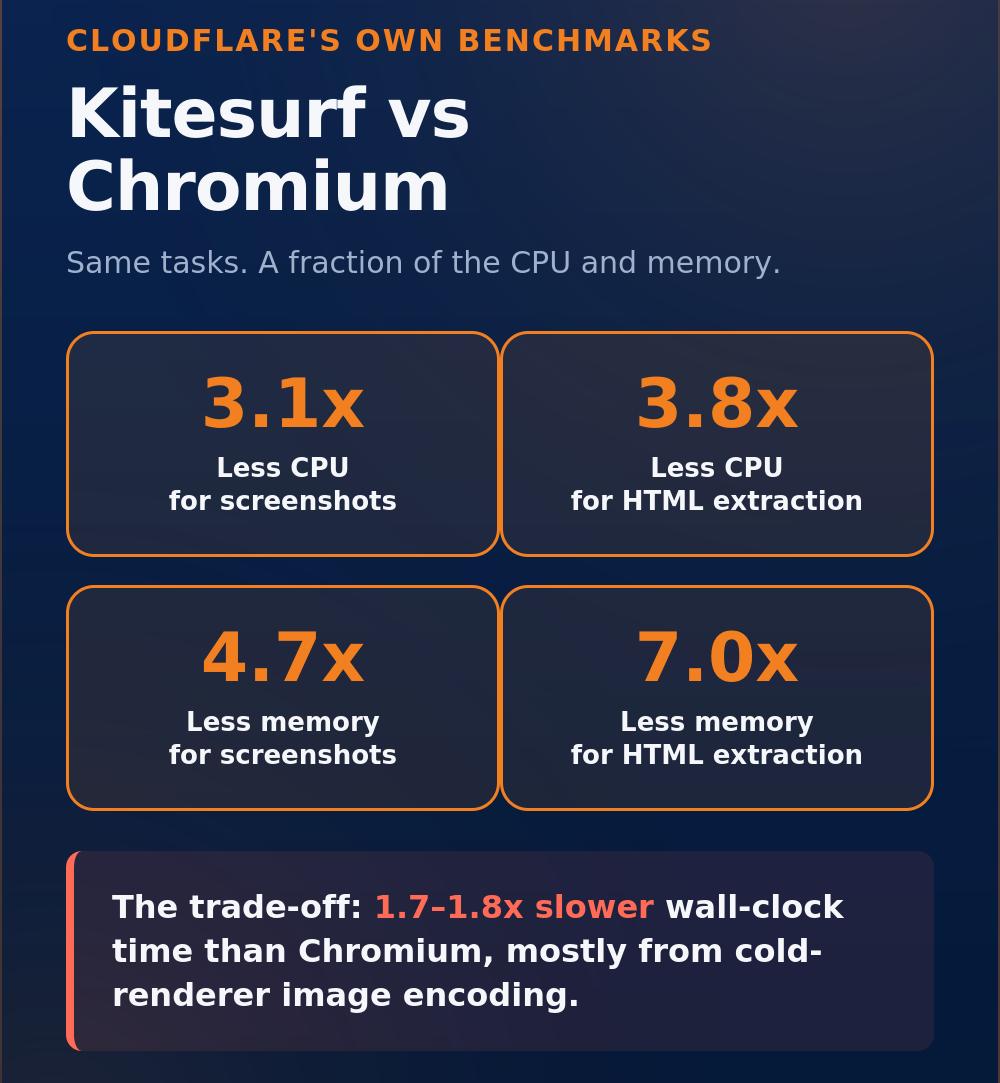
The honest trade-off, and I appreciate that Cloudflare disclosed this themselves rather than burying it, is raw speed. Kitesurf actually took about 1.7 to 1.8 times longer in wall-clock time to complete the same tasks, largely due to rasterization and image encoding overhead in a cold software renderer versus Chromium’s mature JIT compiler. Cloudflare says the browser currently passes over 215,000 Web Platform Tests and is adding hundreds more weekly, which is a reasonable proxy for how quickly the compatibility gap is closing.
How To Get Started With Kitesurf, Step By Step
Getting hands-on with Kitesurf is refreshingly low-friction, and it’s currently free while in beta. If you want to try it without writing a line of code, Cloudflare’s public playground lets you type in any URL and watch Kitesurf render it live, with Chrome DevTools injected directly into the interface so you can inspect DOM elements, console output, and even WebAssembly memory usage per page. You can access that directly here: Kitesurf Playground.
For actual development use, Kitesurf runs through Cloudflare’s existing Browser Run product, and since it speaks the standard Chrome DevTools Protocol, any client you already use, Puppeteer, Playwright, chrome-remote-interface, or an MCP-compatible AI agent, works without modification. The only change needed is appending a browser=kitesurf parameter to your existing Browser Run API calls.
Where Kitesurf Falls Short Today
I don’t think this review would be complete, or honest, without being direct about what Kitesurf genuinely can’t do yet. By Cloudflare’s own admission, it can’t play video, render WebGL, negotiate bot-challenge handshakes with real TLS fingerprints, or maintain long, authenticated sessions with persistent state. For any of those tasks, Cloudflare explicitly tells developers to fall back to Browser Run’s standard Chromium-backed option instead.

That’s a meaningful limitation set, and I think it’s worth being clear-eyed about rather than glossing over in favor of the impressive efficiency numbers. Kitesurf, as it stands today, is genuinely well suited for one-shot, stateless tasks like content extraction, screenshots, and PDF generation from reasonably standard web pages, and genuinely not yet ready for complex, interactive, long-lived sessions on heavily protected or media-rich sites. Cloudflare has also confirmed plans to eventually open-source the project, letting customers deploy their own instances, though no firm timeline has been given for that yet.
Weighing it all together, I think Kitesurf represents a genuinely thoughtful bet on where agentic browsing is heading rather than a rushed me-too product. The security-first isolation model alone is worth paying attention to, and the cost math for anyone running AI agents at real scale is hard to ignore. Just don’t expect it to replace a full Chromium instance for every task yet, because by Cloudflare’s own account, it isn’t trying to.
Disclosure: This is not trading or investment advice. Always do your research before buying any cryptocurrency or investing in any services.
Follow us on Twitter @themerklehash to stay updated with the latest Crypto, NFT, AI, Cybersecurity, and Metaverse news!